 The Wall News
Lessons for the AI SA draft policy
The recent stumbles with the AI-assisted draft policy have given us plenty to think about, and not all of it makes for comfortable reading. The honest takeaway is straightforward: when human oversight is taken out of the loop, things go wrong. It was there for all to see. Sections were generated and pushed through without anyone checking the wording carefully, sources were cited that did not say what was claimed, and a handful of embarrassing errors made it all the way into a public-facing draft. That is the kind of mistake that erodes trust quickly, and trust is far harder to rebuild than it is to lose.
A revised timeline and a fresh set of eyes
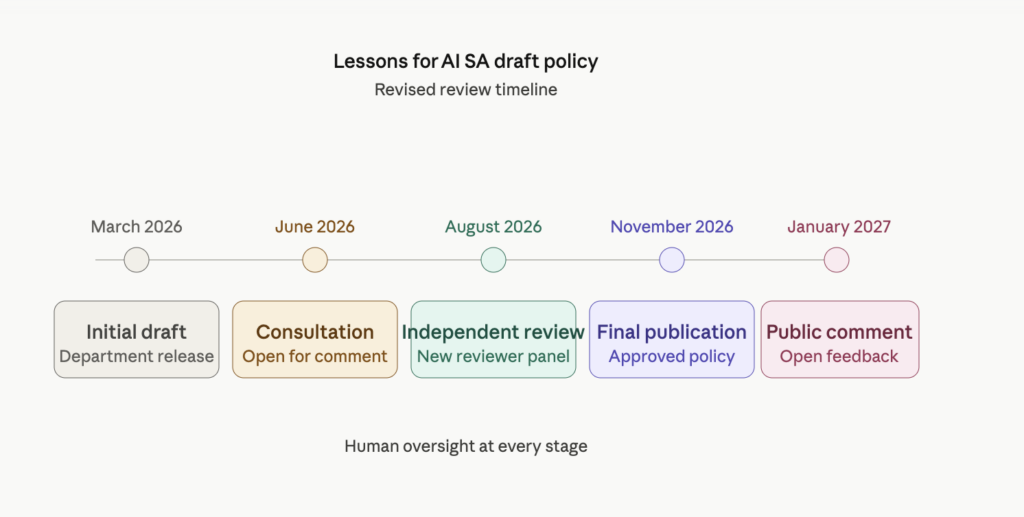
To put things right, the department has agreed to a new set of dates and, just as importantly, a new panel of independent reviewers. The revised timeline allows room to consult properly, to invite scrutiny from outside the team, and to make sure that every claim in the policy is one that can be stood behind. The independent reviewers are not there to rubber-stamp the work. They are there to challenge it, and that is exactly what is needed.
The image above sets out the revised schedule, from the initial draft through to final publication later this year, and on to a further round of public comment opening in January 2027 so that anyone affected has a proper chance to weigh in.
Our jobs are still safe, for now
There is no point pretending the past few weeks have not been awkward. They have. But the bigger lesson, and the more reassuring one, is this: our jobs are still safe, for now. AI is genuinely useful for drafting, summarising and surfacing information, and it has earned a place in the workflow. What it has not earned, and what this episode has made plain, is the right to operate unsupervised.
The technology is simply not mature enough to replace the careful judgement that policy work demands. It does not know our context, our communities, or the consequences of getting the wording wrong. It produces confident-sounding text without knowing whether the text is true. That gap, between fluency and judgement, is where the embarrassment came from, and it is precisely the gap that human reviewers exist to close.
So the message to colleagues who have been worried is straightforward. Keep doing what you do. The tools are here to help, not to take over, and the events of the past few weeks have made it clearer than ever that experienced human judgement is the part of this job that cannot be automated away yet.
What we are taking forward
Use the tools, but keep hands on the wheel. Read every line before it goes out. When something feels off, say so. The new review process is designed to make that easy, not awkward, and the independent reviewers are part of that safety net.
The policy will be got right the second time round, and the work remains in good hands, which are still ours.