 The Wall News
How AI and Machine Learning Can Fix the Home Affairs Corruption Crisis
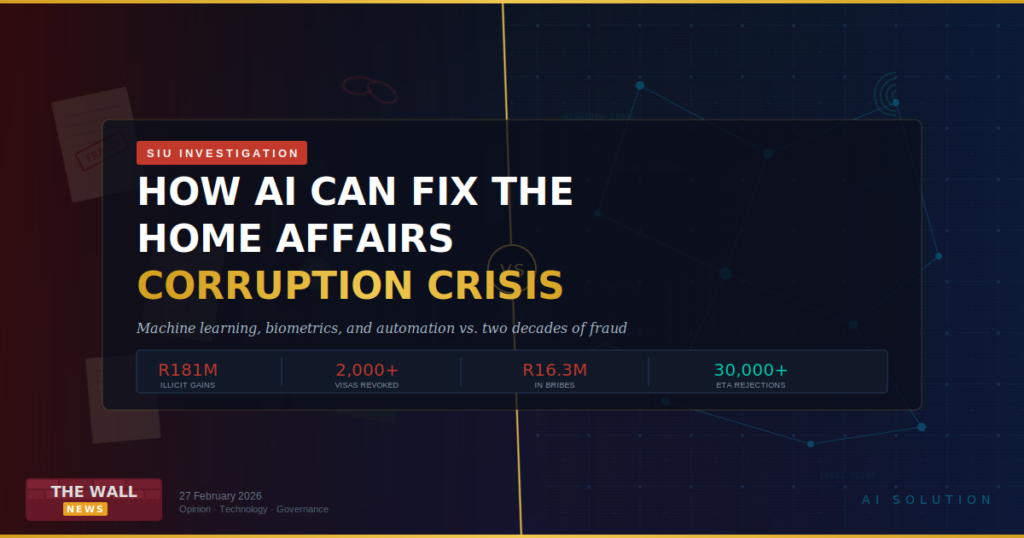
The SIU’s damning interim report has laid bare two decades of rot within the Department of Home Affairs. As South Africa grapples with a broken immigration system, artificial intelligence offers the most powerful remedy yet.
On 23 February 2026, the acting head of the Special Investigating Unit (SIU), Leonard Lekgetho, stood before the nation and delivered a report that should shake every South African to the core. The Department of Home Affairs — the very institution entrusted with safeguarding our borders, our identities, and our sovereignty — had been turned into what Lekgetho described as a “marketplace, where permits and visas were sold to the highest bidder.”
The interim report, authorised by President Cyril Ramaphosa under Proclamation 154 of 2024, paints a devastating picture: a coordinated syndicate of officials earned a combined R16.3 million in bribes, while the broader scheme generated over R181 million in illicit gains. More than 2 000 visas have since been revoked. Officials earning less than R25 000 per month were found to have built mansions and paved private roads to their homes. South Africa’s immigration system was, in the SIU’s own words, “sold one permit at a time.”
But this report is not merely a tale of corruption — it is a clarion call for transformation. Home Affairs Minister Leon Schreiber put it bluntly: paper-based and manual processes have long created space for crooked officials to overlook fraudulent documents and approve applications that do not meet regulatory requirements. The solution? Digitisation, automation, and artificial intelligence. This is not a future aspiration — it is happening now. And it must be scaled up rapidly.
The Anatomy of the Rot: How Bushiri, Omotoso, and Others Exploited the System
To understand why AI is the answer, one must first understand how deeply the system was compromised. The SIU investigation reads like a crime thriller, with some of the most prominent names in the country’s recent controversies at its centre.
Prophet Shepherd Bushiri, the self-proclaimed man of God who fled South Africa while on bail in 2020, had his permanent residence permit approved by an adjudicator who was a member of his own church, ECG Ministries — a blatant conflict of interest that should never have been permitted. The SIU found that Bushiri held directorships in 14 companies and owned multiple properties in Pretoria, with investigators revealing that religious donations were laundered into bricks, mortar, and corporate shares. His application was supported by fraudulent documentation and fabricated financial records that went unchecked because the manual system relied on the discretion of individuals who were compromised.
Nigerian pastor Timothy Omotoso, who was acquitted in 2025 on charges of sexual assault and human trafficking, was found by the SIU to have secured entry to South Africa through a fraudulently obtained work permit issued in a country of which he was not even a citizen, based on an unauthorised directive. His entire immigration pathway was riddled with fraud and misrepresentation. When his initial applications were lawfully rejected, an official without the necessary delegated authority simply granted a waiver — leveraging administrative gaps to override lawful decisions and perpetuate his stay in the country.
Then there is Kudakwashe Mpofu, an undocumented Zimbabwean who purchased a fake permanent residence permit for just R3 000. This single fraudulent document enabled him to secure a position as a CFO in the North West, earning R1.6 million annually. He financed a Land Rover, a BMW, and a Ford Ranger — all on the back of a forged permit. Mpofu was sentenced to three years in prison in November 2025.
Nigerian rapper Prince Daniel Obioma (3GAR) overstayed his visitor’s visa in 2023, left the country, and then re-entered South Africa illegally with no record of his arrival — exposing catastrophic failures in border management and movement control systems. He was later identified after crashing a McLaren 570S supercar at allegedly 200 km/h in Sea Point, Cape Town.
The Loopholes: Why Manual Processes Breed Corruption
The common thread running through every one of these cases is the same: paper-based processes, human discretion, and a lack of integrated verification systems. The SIU itself stated that manual processes have created spaces for corrupt officials to overlook fraudulent documents or approve applications that do not meet relevant regulatory requirements.
Consider the loopholes that were exploited. Officials communicated with applicants directly via WhatsApp to arrange payments. Transaction references in banking records included brazen labels such as “Permit,” “Visa Process,” and “Building Material” — flimsy codes to disguise bribes that were funnelled through spouses’ bank accounts. The same bank statements were likely recycled across multiple applications, and nobody checked. Forged retirement confirmations, fabricated financial means, marriages of convenience, and syndicate-backed sponsorships faking financial stability — all of these slipped through because the system depended on human beings who could be bought.
Perhaps most alarmingly, the SIU, working with Interpol, uncovered a scheme of identity fraud and DNA manipulation. Foreign nationals colluded with departmental officials to gain unauthorised access to Home Affairs offices. The fingerprints of unsuspecting South African citizens were stolen and used while application photographs were swapped with those of foreign nationals to obtain South African passports. DNA samples were also swapped and manipulated to favour foreign nationals applying for permanent residence permits. This is not petty corruption — this is an assault on the very identity infrastructure of the Republic.
The consequences extend far beyond our borders. Individuals with fraudulently obtained South African passports have been caught committing crimes abroad and seeking refugee status in other countries. A passenger was stopped at Islamabad International Airport in Pakistan with a fake South African work visa affixed to his passport. The integrity of the South African passport has been called into question internationally — the United Kingdom revoked visa-free access for South Africans in 2009, partly due to concerns about forged South African travel documents being used by suspected terrorists. Ireland has also raised similar concerns. Every fraudulent document issued in Pretoria or Johannesburg reverberates across the globe.
The AI Solution: Automating Integrity
Minister Schreiber has been unequivocal: “Digitisation is more than a convenience; it is a security imperative. As long as there is a step that requires human involvement or paper application, there is an opportunity for a bribe.”
This is where artificial intelligence and machine learning fundamentally change the equation. AI does not accept bribes. AI does not show favouritism. AI does not communicate with applicants on WhatsApp to arrange payments. AI does not attend the same church as the applicant and approve their permit as a favour. AI applies rules consistently, transparently, and without bias or corruption.
Here is how AI and machine learning can — and already are beginning to — fix the verification problem at Home Affairs.
1. Automated Document Verification and Fraud Detection
Machine learning algorithms can be trained on millions of legitimate documents to recognise authentic passports, identity documents, birth certificates, financial statements, and supporting documentation. When a forged document is submitted — whether it is a fabricated retirement confirmation, a doctored bank statement, or a fraudulent work permit from a country the applicant has no connection to — the system flags it immediately.
One of the most common tactics uncovered by the SIU was the reuse of the same bank statements across multiple applications. AI systems can instantly cross-reference bank statement data across all applications in the database, flagging duplicates and anomalies. If the same R50 000 proof of funds appears in five different permanent residence applications, the system catches it — something a corrupt or overworked official would never do.
The ETA system already does this. Since its launch ahead of the G20 Leaders’ Summit in late 2025, the Electronic Travel Authorisation has declined over 30 000 applications that did not meet the relevant requirements for tourist visas. It uses machine learning to verify the authenticity of documents like passports, and it does so through rules-based decision-making that cannot be manipulated by any official.
2. Biometric Verification: Putting an End to Identity Fraud
The DNA swapping and fingerprint theft uncovered by the SIU is deeply disturbing, but it is also precisely the kind of fraud that biometric AI systems are designed to defeat. The ETA already uses facial recognition technology to match an applicant’s face to their passport photo in real time, ensuring that nobody can enter South Africa using someone else’s documents.
This must be expanded across all visa categories and all ports of entry. Advanced biometric systems — incorporating fingerprint scanning, facial recognition, and iris detection — should be deployed at every Home Affairs office and every border post. When an applicant submits their biometrics, the system should automatically cross-reference against the entire national population register and against international databases through Interpol. If someone’s fingerprints don’t match their claimed identity, the application is rejected instantly — no human intervention required, no opportunity for a bribe.
Minister Schreiber has announced that the department is building an Intelligent Population Register to anchor a new Digital ID system, ensuring that biometrics are recorded for every person in South Africa and that biometric verification protects the citizenship and identity system. This is exactly the right direction.
3. Rules-Based Decision-Making: Removing the Human Element from Approvals
The Bushiri case illustrates a fundamental problem: when a human being has the power to approve or reject an application, that power can be abused. The adjudicator who approved Bushiri’s permanent residence was a member of his church. Omotoso’s rejected application was overridden by an official acting without delegated authority. These are not system failures — they are design failures. The system was designed to rely on human discretion, and corrupt humans exploited that design.
AI-powered rules-based systems remove this vulnerability entirely. Applications are assessed against clearly defined criteria — does the applicant have a valid passport, do their financial records meet the threshold, are their supporting documents authentic, does their biometric data match their claimed identity? If all criteria are met, the application is approved. If any criterion is not met, it is flagged or declined. No official can override the system to grant a favour. No WhatsApp message can expedite a corrupt approval.
4. AI-Powered Monitoring of Home Affairs Officials
Perhaps one of the most critical applications of AI in this context is the monitoring of internal staff. The SIU found that four officials earning less than R25 000 per month received over R16 million in deposits. One official built a mansion while earning a modest civil service salary. These red flags should have been caught years ago.
An AI-driven monitoring system can continuously analyse the behaviour of Home Affairs employees: tracking unusual patterns in application approvals, monitoring for anomalies such as an official approving a disproportionate number of applications from a single country or region, flagging cases where applications are processed unusually quickly or outside normal working hours, and cross-referencing officials’ financial records with their salary levels. If an official earning R25 000 per month suddenly receives R500 000 in bank deposits, the system flags it immediately for investigation. If a particular official’s approval rate is dramatically higher than their colleagues’, the system raises an alert. This kind of continuous, automated oversight would have caught the Home Affairs syndicate years before the SIU investigation.
The SIU itself recommended that Home Affairs consider vetting all employees of the department as one of the measures to address vulnerabilities. AI makes this vetting process continuous rather than a once-off exercise.
5. Financial Document Verification: No More Recycled Bank Statements
AI systems can verify bank statements directly with financial institutions through secure digital channels, eliminating the possibility of forged or recycled financial documents. Machine learning can analyse bank statement formatting, transaction patterns, and metadata to determine authenticity. Cross-referencing tools can ensure that the same proof of funds is not submitted across multiple applications.
Beyond simple verification, AI can assess whether financial records are plausible. If an applicant claims to have R2 million in savings but their transaction history shows a monthly income of R8 000, the system flags the discrepancy. If a “sponsor”’s financial backing appears to be a one-time deposit made days before the application, the system identifies it as potential syndicate backing — precisely the kind of fraud the SIU uncovered.
The ETA: South Africa’s Most Powerful Anti-Corruption Tool — Scale It Up
The Electronic Travel Authorisation, launched in phases from October 2025, is already proving that AI-driven immigration processing works. The system enables visa applicants to apply online, capture biometrics, and receive approvals in real time. It uses machine learning to verify document authenticity and facial recognition to match applicants to their passport photos. It operates through rules-based decision-making that is overseen by the Department but cannot be manipulated by any individual official.
The results speak for themselves: over 30 000 applications rejected for failing to meet requirements — applications that under the old paper-based system might well have been approved by a corrupt official in exchange for a few hundred rands.
Currently, the ETA applies to nationals of China, India, Indonesia, and Mexico arriving through OR Tambo, Cape Town, and Lanseria International Airports. This must be scaled up urgently. The government’s plan to expand the ETA to become the single entry point for all tourist visas, and eventually to all visa categories including study visas and work permits, is exactly right. Minister Schreiber has stated that by moving all visa processing to the ETA, the department will be closing each and every one of the loopholes that were previously exploited.
But the timeline must be accelerated. Every month that passes with parallel manual processing channels still open is another month in which corrupt officials can sell permits. The ETA should be expanded to all international airports and the busiest land ports without delay. All other tourist visa processing, including at South African missions abroad, should be shut down as quickly as operationally feasible. The same system should be extended to student visas, work visas, and permanent residence applications as a matter of urgent national priority.
System Integration: Breaking Down Government Silos
AI can only be fully effective when it operates within an integrated information ecosystem. One of the most glaring failures revealed by the SIU is the lack of information sharing between government departments. Mpofu was able to work as a CFO and finance luxury vehicles despite being an undocumented immigrant because there was no system that cross-referenced Home Affairs records with employment data, the South African Revenue Service, or the Department of Labour.
There must be full system integration between Home Affairs, SARS, the Department of Employment and Labour, the Companies and Intellectual Property Commission (CIPC), the South African Police Service, the Border Management Authority (BMA), and the banking sector. When someone applies for a work permit, the system should automatically verify their employment details with the employer’s PAYE records at SARS. When someone claims directorships in 14 companies, as Bushiri did, the system should cross-reference with CIPC instantly.
The Electronic Movement Control System (EMCS 2.0), which integrates with the ETA using facial recognition at ports of entry, is a step in the right direction. But it must extend to land borders, to refugee reception offices, and to every touchpoint where immigration status is relevant. The days of a person being able to leave the country, re-enter with no record, and live undetected for months — as Obioma allegedly did — must end.
Global Precedents: South Africa Is Not Alone
South Africa is not the first country to recognise that AI is essential for immigration integrity. The global trend is clear, and Mzansi would do well to learn from those who have gone before.
Australia has implemented SmartGates at its airports, using automated facial recognition and biometric data to verify travellers’ identities, reducing wait times and enhancing security. Canada’s Immigration, Refugees and Citizenship department (IRCC) uses machine learning algorithms to triage visa and asylum cases, fast-tracking straightforward applications so that officers can focus on complex or sensitive files, and detecting fraudulent submissions. Singapore has integrated AI into its work visa processing system to assess applicants’ qualifications and predict their potential economic contributions. The United Kingdom uses AI to flag mismatches in employment or education history in Skilled Worker visa applications, and has introduced its own ETA system enforced from early 2026. The United Arab Emirates has deployed AI-powered Smart Gates at airports to accelerate border control and reduce fraud. The European Union is rolling out the European Travel Information and Authorisation System (ETIAS), an AI-driven system that will pre-screen visa-exempt travellers for security and migration risks before they arrive at the border. Kenya and Israel are also implementing electronic travel authorisation systems.
South Africa’s ETA places it among this global vanguard. But the country must move faster. The SIU report has proven beyond any doubt that the old system is not merely inefficient — it is actively enabling crime.
Faster Service, Shorter Queues: AI Benefits for Ordinary South Africans
The benefits of AI at Home Affairs extend far beyond fighting corruption. Anyone who has ever spent an entire day queuing at a Home Affairs office — only to be told at 3pm that the system is offline — knows that the department’s service delivery is in crisis.
AI-driven processing dramatically reduces turnaround times. When visa applications are assessed automatically against clear criteria, the weeks-long waiting periods associated with manual processing are compressed to hours or even minutes. The ETA system already processes applications within 24 hours, with automatic notification of approval or rejection. Imagine that same efficiency applied to ID applications, passport renewals, and birth certificate registrations.
Minister Schreiber’s vision of “Home Affairs @ Home” — where citizens can access services digitally without physically visiting an office — would dramatically reduce overcrowding, eliminate the infamous queues, and free up office staff to assist those who genuinely need in-person help, such as the elderly or those without internet access. Biometric self-service kiosks and online portals can handle the bulk of routine transactions, transforming Home Affairs from a place of dread into a modern, efficient government service.
Upskilling, Not Replacing: Protecting Honest Workers
A critical concern that must be addressed head-on is the impact of automation on Home Affairs staff. Minister Schreiber himself acknowledged the role of ethical officials within the department, calling for a cultural shift. The vast majority of Home Affairs employees are honest, hardworking South Africans who are not part of any syndicate. They must not be left behind.
AI should not be deployed to replace good employees — it should be deployed to empower them. Routine, repetitive tasks such as data capture, document verification, and basic eligibility checks can be automated, freeing staff to focus on complex cases that require human judgement, empathy, and expertise: processing refugee claims, assisting vulnerable applicants, investigating edge cases, and providing face-to-face support.
The Department must invest in a comprehensive skills development programme for its workforce. Staff must be trained in digital literacy, AI system management, cybersecurity, data analysis, and fraud detection. Those who currently process paper applications should be retrained to oversee automated systems, manage exceptions, and interpret AI-generated alerts. This is an opportunity to professionalise the Home Affairs workforce and create higher-skilled, better-paid positions — not an excuse to retrench workers.
South Africa cannot afford to create more unemployment in the name of modernisation. The transition to AI must be managed with sensitivity, with reskilling programmes, transition support, and clear career pathways for existing staff. The goal is a smaller but more capable, better-equipped, and better-compensated workforce that takes pride in serving the public with integrity.
A Note on Fairness: AI Does Not Discriminate
One of the most insidious aspects of the old system was its inherent unfairness. If you could afford to pay a bribe, you could get a permit. If you knew someone on the inside, your application sailed through. If you were a powerful religious figure with a large following, officials would bend the rules for you. The system rewarded wealth, connections, and influence — not merit or lawful qualification.
An AI-driven system applies the same rules to every applicant, whether they are a millionaire televangelist or an ordinary worker applying for a visa extension. There is no favouritism, no conflict of interest, no “special arrangements.” The criteria are transparent, the process is auditable, and the outcome is based solely on whether the application meets the lawful requirements. This is the kind of equal treatment that the Constitution demands but that the manual system spectacularly failed to deliver.
Of course, AI systems must themselves be designed carefully to avoid algorithmic bias — a well-documented concern in global AI deployment. The training data must be representative, the rules must be regularly audited, and there must be transparent appeal mechanisms for applicants who believe they have been wrongly assessed. But these are solvable technical and governance challenges. They are infinitely preferable to a system where a R500 e-wallet transfer to a corrupt official determines your immigration status.
Conclusion: The Next Twenty Years Must Be Different
The SIU’s interim report has exposed a system that was rotten from the inside out for the better part of two decades. Prophet Bushiri, Pastor Omotoso, Kudakwashe Mpofu, and countless others exploited a department that relied on paper, human discretion, and a culture of impunity. The cost has been measured not only in rands — though R181 million is a staggering figure — but in the erosion of South Africa’s sovereignty, the integrity of its identity system, and the trust of its citizens.
Artificial intelligence and machine learning are not silver bullets. They must be implemented alongside robust legal frameworks, vigorous prosecution of the corrupt, meaningful consequences for those who abuse their positions, and genuine political will to see transformation through. The National Prosecuting Authority must fast-track the criminal referrals arising from this investigation. Officials who built mansions on bribe money must face the full force of the law.
But the technological solution is clear. The ETA must be scaled up to cover all visa categories and all ports of entry. Biometric verification must be universal. System integration between government departments must become a reality, not a promise. AI monitoring of officials must be implemented to catch the next syndicate before it costs the country millions. And honest Home Affairs workers must be upskilled and supported to thrive in the new digital environment.
Minister Schreiber said that the next twenty years of Home Affairs must be better than the previous twenty. With AI, machine learning, biometrics, and genuine commitment to digital transformation, they can be. The technology exists. The blueprint is there. Now it must be delivered — urgently, comprehensively, and without compromise.
The Wall News Editorial
Your Source for Urban Updates
Published 27 February 2026 · Cape Town, South Africa
Disclaimer: This article is based on publicly available information from the SIU’s interim report released on 23 February 2026, statements by the Minister of Home Affairs, and government publications. All individuals mentioned are entitled to the presumption of innocence. The views expressed are those of the editorial team and do not constitute legal advice.